
Introduction
A bit over 375 years ago, the General Assembly of the Church of Scotland authorized the 1650 psalter as the sole songbook of that church. After a staggering 375 years of continual use, let us take a moment to appreciate its history and consider some present day developments.
We begin with its history.
Its History
I. The Westminster Assembly
What we call the 1650 Psalter was the product of the Westminster Assembly. The Assembly was in pursuit of uniformity of religion for the three kingdoms of England, Scotland, and Ireland. The Authorized Version of 1611 had produced a standard English translation of the Bible. But also, it was necessary to have a uniform psalm book.
The starting point for this psalter would be Francis Rous’ version. Three committees of the Assembly were responsible for scrutinizing 50 psalms each and revising that psalter. The skill and ability of the members of the Assembly to do such a work has been unsurpassed in the time since. The product of this was the Metrical Version that we now call the 1650 psalter.
II. The General Assembly of the Church of Scotland
In 1647, the General Assembly of the Church of Scotland examined the psalter which was produced. In 1649, by an Act of the Commission of General Assembly it was approved.
The Commission of the General Assembly having with great diligence considered the paraphrase of the Psalms in metre, sent from the Assembly of Divines in England, by our Commissioners, whilst they were there, as it is corrected by former General Assemblies, committees from them, and now at last by the brethren deputed by the late Assembly for that purpose: and having exactly examined the same, do approve the said paraphrase as it is now compiled: and therefore according to the power given them by the said Assembly, do appoint it to be printed and published for publick use; hereby authorizing the same to be the only paraphrase of the Psalms of David to be sung in the Kirk of Scotland; and discharging the old paraphrase and any other than this new paraphrase to be made use of in any congregation or family after the first day of May in the year 1650. And for uniformity in this part of the worship of God, do seriously recommend to presbyteries, to cause make publick intimation of this act, and take special care that the same be timeously put to execution, and duly observed.
Act of the Commission of the General Assembly for Publick Affairs
—A. KER.
EDINBURGH, November 23, 1649. Post meridiem.
From the first day of May 1650, for the sake of uniformity, this Metrical Psalter would be the sole psalm book used in the Church of Scotland. The General Assembly would commend the 1650 psalter by saying it was “more plain, smooth and agreeable to the Text than any heretofore”.
A Renaissance
Since that time, for 375 years, the 1650 psalter has remained in continual use. Recently, it has even enjoyed a bit of a renaissance as psalm singing is being cherished once again. In the past year there has been a flurry of activity surrounding the psalter. A new edition of the free digital 1650 psalter (iOS, Android) has been released. Grange Press released a version with John Brown of Haddington & David Dickson’s meditations. SermonAudio released the Foundations Psalter to a wide audience beyond the Reformed Churches. The Divine Covenant Psalter was released by Christ Covenant Church (RPCGA) and includes integrated music for every selection.
The versatility and excellence of the psalter is being appreciated by a modern audience. Many of whom have no background in the Reformed Churches. That is especially exciting for those of us who believe that the Lord has commanded that his psalms be sung in worship. But why has the 1650 psalter endured for 375 years as the de facto English language psalter? Let us consider some of its excellencies.
Its Excellencies
I. A faithful translation
The 1650 psalter is an extremely faithful translation of the underlying Hebrew text by leading scholars at the time. It is obvious that the men who did the translation work knew the Scriptures and that influenced how they set the psalms to meter. Even words “added” to fit the meter are not superfluous but come out of the sense of the Hebrew text.
II. Preeminence given to the Word
The 1650 psalter gives the preeminence to the Word of God. Other metrical psalters may elevate the tune chosen for a psalm above its words. But by making the decision to decouple the tunes from words, the words of the psalter were allowed to stand on their own.
III. Simple to sing
The first psalter I ever used was a modern translation. I still appreciate that psalter. However, there were many selections that I could not sing because the tunes were complex for someone without a musical background. To this day, there are still sections of that psalm book that I cannot sing in private or family worship. But God has commanded all of his people to sing all of his psalms no matter how musically inclined they are. We are always in the danger of creating a new Levitical order of musicians in the church as intermediaries between us and God, and we must be aware of that.
Thankfully, the 1650 psalter was made so that even the least musically gifted person can sing through the entirety of it. All of the selections (save Psalm 136) have a Common Meter version. One can therefore sing through 99% of the psalter by only knowing a single tune. With two tunes, one can sing the entirety of it. This is a great help to many of us who have not grown up with congregational singing and are not musically gifted.
That this was a fundamental aim of the psalter is found in Francis Rous’ words:
True it is, that in a former edition, Psalms have been set forth in measures fitted for more difficult tunes, which are still to be seen. But it was objected by very good judgments that if such difficult tunes were allowed, some man willing to make use of them, if not sure of his skill, might begin a Psalm in a tune wherein the congregation might be put to a loss. They might either fail to follow him at all, or follow him in a discord instead of a harmony. Indeed, it is suitable to charity that those that have skill should condescend to them that have none, and not by that skill hinder edification of the unskilful
(Rev. David Silversides pulls this quote from Clugston’s work The Making and Marring of the Scottish Psalter, John Locker Clugston, Reformer Print, Sydney, 1974. This is not a work that I possess, so I cannot verify the citation).
So, not only is the 1650 psalter excellent in terms of its faithfulness to the text, but the pastoral heart which went into it ought to be appreciated as well.
IV. Uniformity
Modern psalters come and go at a dizzying pace like modern English Bibles. From generation to generation we all seem to memorize different things. This has contributed towards the fragmentation and splintering of the church as we no longer speak or sing the same thing.
As an example of this, in my prior denomination, the denominational home for the aged used an older psalter published by that denomination. The reason for that is that the saints in the home had memorized the psalms from the older translation. With failing eyes, but not failing hearts, they sang the praise they had memorized. It was beautiful to see how these saints had hidden the Word in their hearts. However, younger generations in that denomination were memorizing a newer translation. Like many things in the modern church, there had become a generational divide.
But when the 1650 is memorized, as a fixed text psalter, the whole English speaking world can sing the same praise to God and sing with uniformity as was the desire of the Westminster Assembly. Personally, I saw this in action last year when I had the great privilege of speaking at a Church Conference in Singapore, which is an English speaking nation. The brethren in Singapore sang the same praise from the 1650 as I do in Fredericksburg, VA. The ubiquity of the 1650, not tied to any single denomination, makes it an ecumenical psalm book of the English speaking world to this day. Even modern psalters retain some of its selections (such as the 23rd psalm), as the 1650, like the Authorized Version of the Bible, has become ingrained in the church.
Lord willing, one day, we will seek after uniformity of religion again in the English speaking church, and perhaps new translations like the Authorized Version and the 1650 Psalter can arise that will unify God’s people. But that day is not yet here.
Its Difficulties
Is it a perfect psalter? No. Here are some issues to be aware of.
First, the divine name of God (JEHOVAH) is not always clear in reading the psalter in most editions due to a lack of indication in the text when it is being used. The Divine Covenant Psalter (Christ Covenant Church, RPCGA) aims to remedy that.
Second, there are words that may be difficult for the modern reader. In my experience, that difficulty is often overstated, and there are only a few words one might need to learn.
Lastly, as with every English metrical psalter, some accommodation (usually additional words) are needed to make the translation fit the meter. As mentioned before, the translators did not seek to pull these additional words, when needed, from thin air. Rather, they are often placed to fit the sense of the Hebrew text.
So, it is not a perfect psalter. However, in spite of these drawbacks, the benefits of the 1650 far overshadow its negatives. It was certainly the product of a better and more spiritual time.
No modern English psalter has excelled it to this date.
As a Digital Psalter
Rather interestingly, the 1650 psalter is well suited for a digital format due to the lack of copyright and flexibility of the matching of tunes to the words. Digital allows for what paper cannot. Around seven years ago, I released the 1650 Split Leaf Psalter on the App Store and Google Play. That app introduced psalm singing to tens of thousands of people. To this day, saints all over the world continue to use it and have conveyed to me how the Lord brought them to sing the psalms by it.
But now there is a new edition of that digital psalter for iOS & Android. The new edition has the option to integrate the psalter’s words with a tune, as modern psalters do. With the 1650 psalter allowing one to mix and match any tune (of the appropriate meter) to the text, the 1650 makes for an ideal digital psalter that can be customized however one wishes.
This is something that paper could never have done — the closest paper can come is the split leaf format or to fix each psalm a certain tune. But now, 375 years later we can do generate something like this on the fly by integrating the tune dynamically with the words.
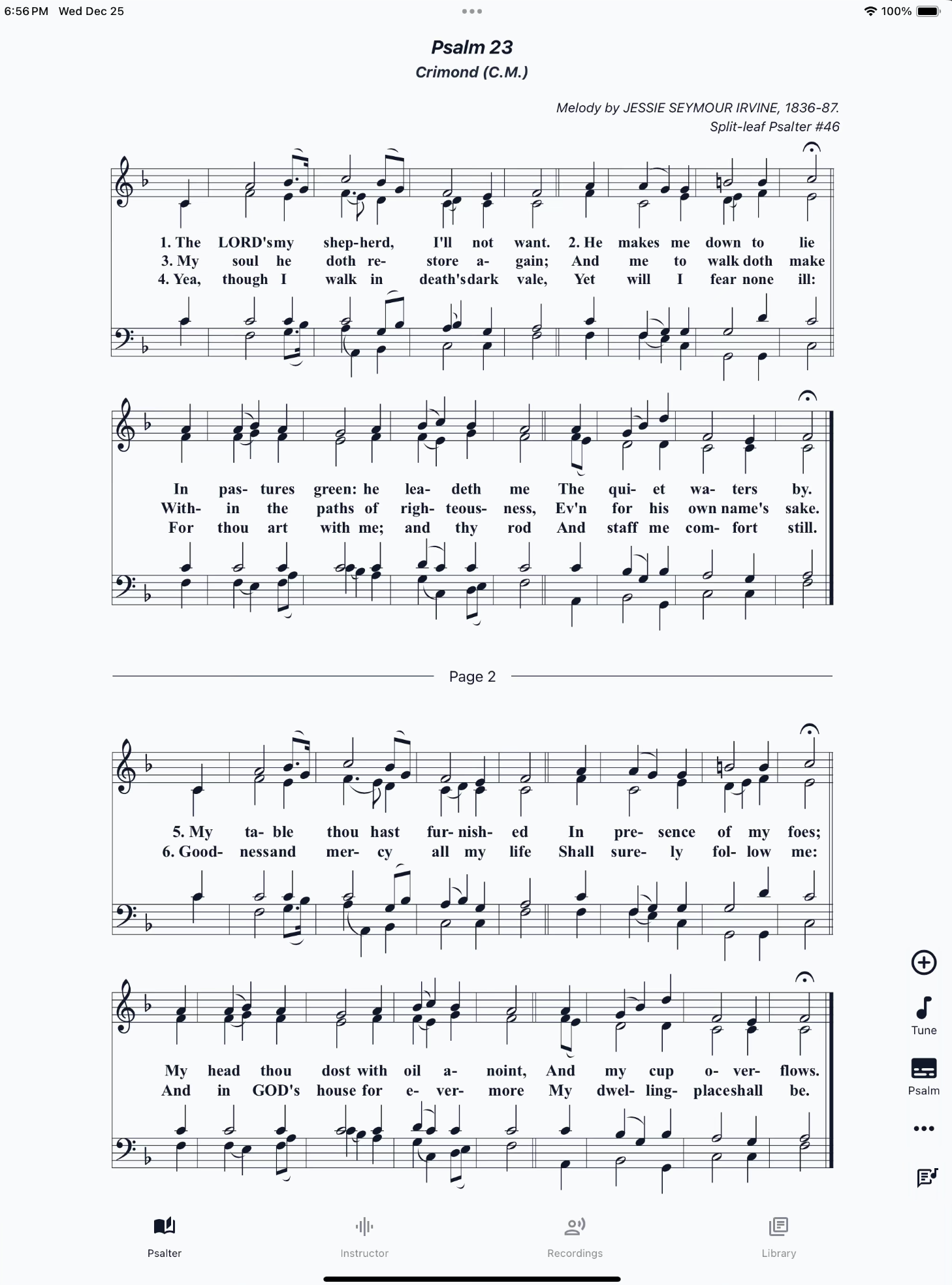
This opens up a whole new realm of possibility in use of the 1650 psalter. This new digital psalter also contains congregational singing to help sing along to the psalms without instrumentation. As the 1650 psalter heads into its fourth century of use, such tools are bringing it back.
In an upcoming release, the digital psalter will also supply definitions of archaic words by tapping on them. Stay “tuned” for more developments as the digital psalter continues to take advantage of what we can do with modern technology.
One note on the new digital psalter: it is the product of many men’s labors. For this new version, Ryan Bender did the coding, Samuel Ho supplied the psalter text. Lucas Donato and Jason Ray translated the tunes into ABC notation. I oversaw the project and managed it.
Praise God
Finally, with this resurgence, and with all of these resources, let us not forget the purpose of the psalm book – to praise God. Cultivate a heart of worship and take up these precious Psalms to praise our Lord Jesus with his own word. Worthy is the Lamb to be praised. The psalm book is the means to that end.
Colossians 3:16 – Let the word of Christ dwell in you richly in all wisdom; teaching and admonishing one another in psalms and hymns and spiritual songs, singing with grace in your hearts to the Lord.
Resources
Find the iOS edition of the psalter here.
Find the Android beta for the psalter here.
Order Grange Press’ 1650 Psalter here.
Order the SermonAudio Foundations Psalter here.
For information on the development and the excellencies of the 1650 Psalter, see Rev. David Silversides’ address on it. https://media.fpchurch.org.uk/2024/02/The-Development-of-the-Scottish-Psalter-David-Silversides.pdf
More information on the psalter can be found on Sean McDonald’s site devoted to the 1650 and its history: https://1650psalter.com/introduction/
 Christ, Code, and Kids
Leave a comment